“Realign stories, then simplify filing systems”
5 notes from the book ‘Nexus’ by Yuval Noah Harari, leading to the take-away quote.
1.
Homo sapiens didn’t conquer the world because we are talented at turning information into an accurate map of reality.
Rather, the secret of our success is that we are talented at using information to connect lots of individuals.
Story, printing, internet… now AI.
We use information to manage big networks. Networks we call ‘countries’, ‘companies’, ‘movements’ and more.
2.
The naive view of information says information leads to truth which leads to wisdom and power.
The more complete version decipers information leading to truth and order, with order leading to power, and truth to wisdom and power.
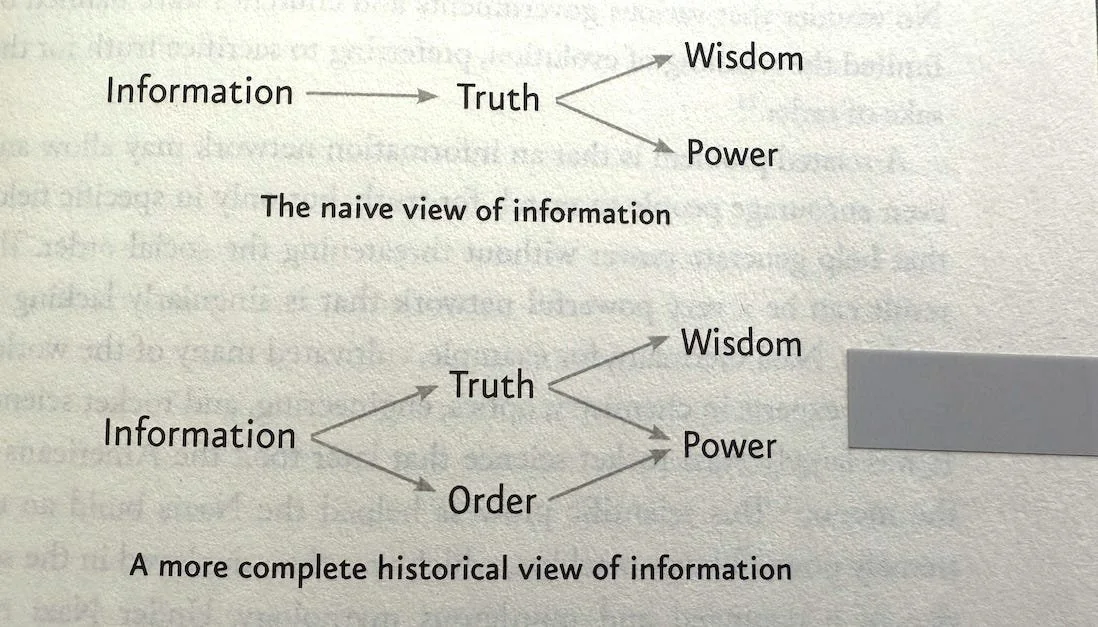
Views on information by Yuval Noah Harari
Networks with more truth, like a scientific community with self-correcting mechanisms, are prone to more instability. Networks with more order, like a dictatorship, are prone to more false truths.
3.
We create labels and categories to bring order to information. We then call them bureaucracy.
They [Order] are human-created and therefore fallible.
As a consequence, when someone or something doesn’t fit into the box we created, we have to give up on a piece of truth for order.
The power and wisdom also shifts to human-to-document connections, which are often less easily understood by human brains.
They can also determine someone’s fate, even when ‘reality’ is different from the documents.
4.
In (tribal) societies that lack written documents and bureaucracies, the human network is composed of only human-to-human and human-to-story connections.
Authority [Power] belongs to the people who own these stories.
In human networks with documents and bureaucratic procedures, in addition to human-to-human and human-to-story connections, such societies are held together by human-to-document connections.
Authority [Power] shifts to experts in these documents: people who know their way around loopholes and labyrinths of offices, committees and subcommittees [office politics].
5.
Documents are created to bring order to information and stories.
However, with more documents emerging, two new challenges arise:
With more documents storing information, a filing system needs to bring order to retrieve the right information from the right documents. This system is also fallible. This can create a loop of creating more documents and systems.
With more documents sharing stories, people come up with different interpretations of those stories, sometimes leading to new networks overall. This happened to Christianity with the protestant vs. catholic movement.
Take-away from 1-5.
I see similarities between <50p. companies and networks that lack bureaucracy. Change can be brought here through story.
I see similarities between >50p. companies and networks creating bureaucracy. Change can be brought here by introducing documents.
I see similarities between >100p. companies and the different interpretations of story in company culture, as well as the red tape in even larger organisations. Change can be brought here through realigning stories and simplifying filing systems.
